

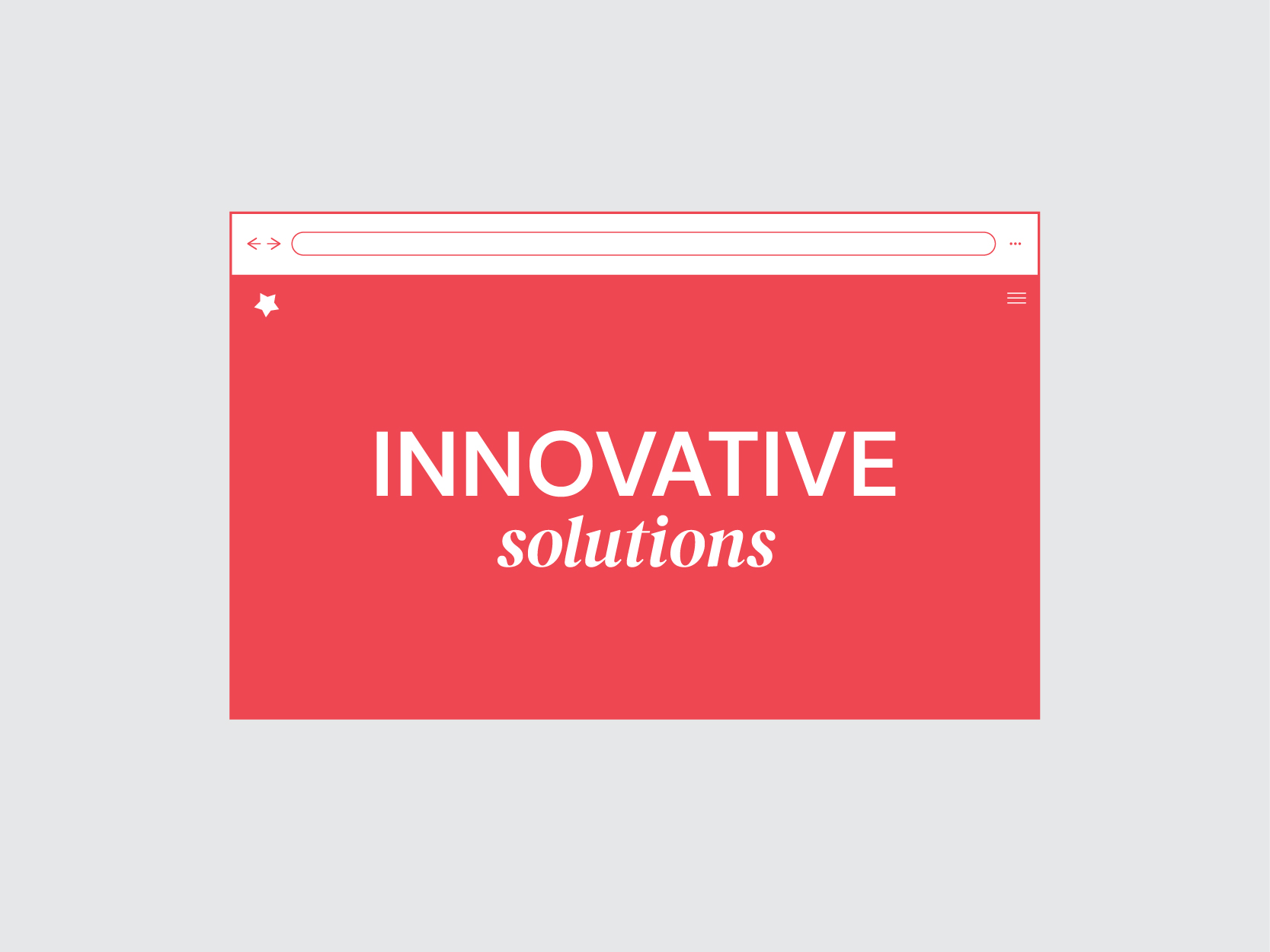
Honestly? The word "innovative" alone should set off alarm bells. There ought to be a registered mark for it, a kitemark you only get to display if you've genuinely earned it. If you invented graphene, or created an entirely new market the way Apple did with the App Store, fine. Put it on everything. But if you've added a dropdown menu to your dashboard and you're calling that innovative? You don't get the word.
The problem is that nobody's policing the door. So every brand walks through it, and the word means nothing anymore.
Open your browser. Type in three competitors. How many of them are "innovative"? How many are "passionate about delivering results" or "committed to excellence"? If you work in B2B, you already know the answer.
When every brand in a category uses the same vocabulary (you know the ones, transformative, solution-driven, future-focused) the words stop meaning anything at all. They become visual wallpaper. Present, but completely unseen. And "innovative solutions" is the worst offender of the lot. Two words used so promiscuously, so carelessly, that they now communicate precisely nothing about who you are or what you actually do.
Brands don't default to generic language because they're not trying. They do it because of something more insidious: groupthink. Or doubt. Or perhaps worst of all, someone in the room projecting their own tastes and preferences onto work that was never meant to speak to them.
This alone is one of the most effective strategies for dilution there is. A bold, specific piece of messaging goes into the process. It gets reviewed, questioned, softened by committee, and second-guessed by someone who "just wants to make sure we're not alienating anyone." By the time it comes out the other side, it's been watered down to something with all the impact of used washing up water.
Nobody meant for it to happen. It rarely does. But the road to invisible branding is paved with good intentions and too many opinions.
Vague language doesn't just fail to impress it actively costs you. In B2B, where buying cycles are long and decisions involve multiple stakeholders, unclear positioning creates friction at every stage. Prospects can't self-qualify. Sales teams over-explain. Proposals end up doing the work the website should have already done.
And the brands that can't differentiate on value? They compete on price instead. That's not a coincidence; it's a direct consequence of unclear positioning.
The fix isn't clever copywriting. It's clarity of thought.
Speak your customer's language, not your internal one. The words they use on a frustrating Tuesday afternoon are worth more than any tagline your team spent three weeks debating. Lead with outcome over process, "you'll spend less time chasing approvals" beats "we provide streamlined workflow solutions" every time. And be specific about the problem you solve, not just the category you sit in.
Most powerfully: own a point of view. A brand with a clear, confident opinion on its industry is infinitely more memorable than one dressed up in adjectives. Specificity isn't a risk, it's the whole point.
Take It's Interventional, a Sheffield-based distributor of medical devices. Few sectors carry higher stakes than this one; these are products that directly affect patient outcomes. And yet, like so many in their industry, they were leading with the same tired phrase: "Quality and innovation." Safe. Sector-standard. Invisible.
When they chose to move toward a warmer, more inclusive tone — one that put patients genuinely at the centre of everything — some might have seen it as a risk. In a traditionally clinical, risk-averse sector, warmth can feel dangerously close to being unserious. In fact, the opposite was true. The shift didn't diminish the gravity of what they do. It reflected it. Because caring deeply about patients isn't soft, it's the whole point of the business.
Go to your homepage right now. Read the first two sentences. Would a complete stranger know exactly what you do, who you do it for, and why it matters?
If there's any hesitation, that's your brief.
The brands that win in B2B aren't always the biggest or the best-resourced. They're the ones with the clearest voice. And clarity, unlike innovation, is actually quite rare.
We offer an honest sense-check, no agenda, no jargon, no "innovative solutions." Just a straight conversation about whether your brand is working as hard as it should be.
Get in touch. We'll tell you what we actually think.


