

Then a potential client starts looking for a supplier in their space. They ask around, do a bit of research, check a few websites.
They don't get a call.
Not because no one's heard of them. But because being heard of wasn't enough.
Here's the question worth sitting with: Is your brand familiar, or is it trusted?
In B2B, those are not the same thing. And for many small and mid-sized businesses, confusing them is quietly costing deals they don't even know they're losing..
Being well-known means occupying space in someone's memory. Your name rings a bell. They've seen your logo, come across your LinkedIn content, maybe met you at a networking event.
Being well-regarded means occupying a position of credibility and genuine preference in someone's decision-making. When the moment comes to choose a supplier, they think of you — or better still, someone else mentions you first.
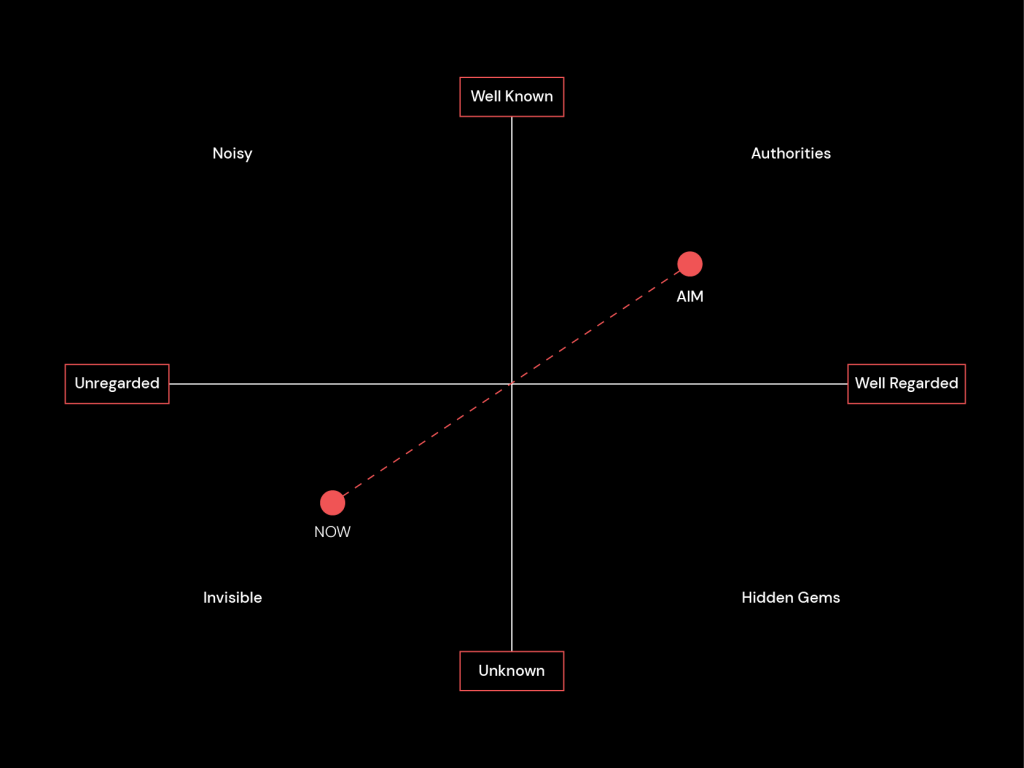
It helps to think about where businesses tend to sit across these two dimensions:
Unknown and unregarded. Not yet visible. Common early on, and the fix is straightforward: get out there.
Well-known but not well-regarded. Active, but not yet trusted. Recognisable, without the substance to back it up.
Well-regarded but not well-known. A hidden gem. Good reputation, not enough reach. The quality is there; it just isn't spreading far enough.
Well-known and well-regarded. Earned authority. This is the goal, and it's where real commercial momentum comes from.
Most B2B businesses focus their energy on moving from unknown to well-known. More LinkedIn posts. More networking. More visibility. All reasonable things to do.
But the real commercial leverage sits in moving from well-known to well-regarded. That's a different problem and it needs a different approach.
This isn't down to a lack of effort. It's usually down to how progress gets measured, and where ideas about marketing come from.
Visibility is easier to see than trust.
Follower counts, post engagement and event attendance; these are easy to track and satisfying to report. The slower work of building genuine credibility is harder to put a number on, so it tends to get less attention. What gets measured gets prioritised. Everything else quietly waits.
A lot of B2B marketing borrows from a B2C playbook that doesn't quite fit.
Consumer brands build awareness through repetition; see it enough times and you start to trust it. That logic has some truth in low-stakes decisions. But B2B buyers, even at smaller businesses, aren't choosing a supplier the way they choose a coffee brand. They're making a decision they'll have to stand behind. Familiarity helps get you noticed. It doesn't get you chosen.
The business gets mistaken for the founder.
This one is especially common in owner-led SMEs. The founder builds a genuine reputation, a local network, a following and a name people recognise. The business benefits. But when the founder isn't in the room, when someone else picks up the phone, or a prospective client looks at the website without any prior introduction the brand has to carry the conversation on its own. If it can't, that's a problem. People buy from people, yes. But they also need to trust the business behind the person.
There's no clear internal owner for trust.
Raising awareness has natural owners, whoever's running marketing, whoever's posting on LinkedIn. But credibility and reputation tend to fall between the cracks. Nobody's quarterly target is "be more trusted." So it doesn't get the same sustained attention.
Well-regarded businesses leave particular kinds of traces. Here's what to look for:
People mention you when you're not around. A prospect brings up your name because someone in their network recommended you, unprompted. That kind of referral isn't luck, it's the result of having made a strong enough impression that someone felt confident passing your name on.
You're considered without having to push for it. Not every opportunity starts with a cold outreach or a warm introduction from someone on your team. Some just arrive, because your reputation did the groundwork.
Your pricing holds up. When buyers genuinely trust you, cost isn't the only thing they're weighing. They're also weighing risk, reliability, and confidence. A business with real regard behind it doesn't have to discount its way to a yes.
Good people find their way to you. Word travels in both directions. A business that's well-regarded by clients tends to attract better staff too, often without actively recruiting.
Competitors start to position themselves against you. It sounds counterintuitive, but when other businesses in your space begin referencing you as the standard to beat, that's a meaningful signal. If a competitor's pitch includes a slide explaining why they're a better alternative to you, or a new entrant in the market frames their offering by comparison to yours, you've become the benchmark. That doesn't happen to businesses that are merely well-known. It happens to businesses that are genuinely well-regarded.
Clients don't drift. They renew. They refer others. They give honest feedback because they want the relationship to work. Retention and referrals are quiet but reliable indicators of regard.
One line that draws the distinction clearly: well-known businesses get considered. Well-regarded businesses get chosen.
The gap between being known and being trusted matters everywhere, but it shows up differently depending on the industry.
Medtech and healthtech
In regulated, high-stakes environments, being recognised isn't enough. The people involved in supplier decisions such as procurement leads, clinical teams or compliance managers need to be able to justify their choice. A supplier that's visible but inconsistent in how it presents itself, or unclear about what it actually delivers, will lose to a less prominent competitor that feels safer to back. In these environments, doubt is often enough to rule someone out.
Manufacturing and engineering
Sales cycles are long, and impressions accumulate over months. A business that shows up a lot but doesn't have a clear or consistent story risks eroding confidence rather than building it. Buyers in these sectors pay close attention to whether a supplier knows its own mind. Inconsistency in messaging by saying different things in different places, or shifting positioning from one conversation to the next, reads as a warning sign.
B2B SaaS
In most SaaS categories, there's no shortage of options. The most visible businesses aren't always the most trusted ones, they're often just the ones spending the most. Decisions in B2B SaaS are usually made by more than one person, over a longer period, and with significant weight placed on peer recommendation and proof of results. Being seen everywhere counts for less than being genuinely recommended by someone the buyer respects.
A few honest questions are worth more than any formal audit. Work through these and see where you land.
1. If someone encounters your business for the first time without an introduction, what do they find, and does it build confidence?
Try it yourself. Search for your business the way a stranger would. Read the website with fresh eyes. Look at your LinkedIn presence. Does it feel like a business with real substance, or does it feel like a business telling you it has substance?
2. Are you getting enquiries that didn't start with your outreach?
Think back over the last six months. How many new conversations began because someone came to you through a referral, through your content, through your reputation rather than because you went to them? If the answer is very few, awareness may be outrunning regard.
3. Do clients describe you in ways you didn't hand them?
When clients talk about working with you, do they use their own words specific, personal, genuine or do they echo back your own marketing language? Clients who genuinely value a business tend to express it in ways that go beyond the talking points.
4. When you're not the cheapest option, do you still win?
Losing on price is sometimes unavoidable. Losing on price consistently is worth examining. Often it means buyers don't yet have enough confidence in you to justify paying more.
5. Does your business hold up when you're not personally in the conversation?
If deals only move forward when the founder or a particular salesperson is involved, ask why. Strong businesses don't depend entirely on individual relationships. The brand should be doing some of the work.
If the honest answer to most of these is "not really" or "I'm not sure" visibility is probably ahead of trust.
None of this means stopping the things that build visibility. It means being deliberate about what you're building towards.
Depth matters more than volume.
One piece of content that's genuinely useful that answers a real question, takes a clear position, or demonstrates real expertise will do more for your reputation than ten posts written to chase engagement. Quality leaves an impression.
Have a point of view.
Businesses that are well-regarded tend to stand for something. They have a perspective on their industry. They're willing to say what they think, even when it's not the crowd-pleasing answer. A business with no clear position on anything is hard to remember and harder to trust.
Let clients tell the story.
A well-written case study, an honest testimonial, a referral from someone who's worked with you all carry a weight that your own marketing never quite can. Buyers trust people like them more than they trust the businesses selling to them. Every client willing to speak up on your behalf is worth a great deal.
Show up consistently.
Trust builds over time and through repetition but only if what people see is consistent. If your website says one thing and your LinkedIn says another, if your tone shifts depending on who wrote the content, if your positioning changes with the wind, confidence erodes rather than grows. Consistency isn't exciting, but it's what trust is built from.
Start from the inside.
If the people who work for the business don't genuinely believe in what it offers, that eventually shows. The way a team talks about their work, the standards they hold themselves to, the care they take with clients all feeds into how the business is perceived externally. Reputation isn't just a marketing question. It's a business-wide one.
Come back to that business from the opening. Active on LinkedIn, building a local presence, doing the right things. Not getting the call.
Not because nobody knows them. Because in the moment it mattered, they hadn't yet given buyers enough reason to feel confident choosing them.
Visibility got them into the consideration set. Regard would have got them the contract.
The goal was never to be the most well-known business in your space. In B2B, the goal is to be the one that serious buyers feel good about choosing; the one that gets recommended by people who've worked with you, that holds its value when a decision gets down to the wire, that clients stick with because they genuinely trust what you deliver.
That takes longer to build than a following. It's harder to put on a slide. And it's worth considerably more.
*If you're not sure whether your brand is building visibility or building trust — that uncertainty is probably telling you something.*
If this article has prompted a few uncomfortable questions, that's a good sign; it means there's something worth looking at.
We offer a brand audit for B2B businesses that want an honest, outside view of where their brand is doing the work and where it isn't. No jargon, no lengthy process. Just a clear picture of how your business comes across and where the gaps between visibility and trust are costing you.
Book your brand audit or get in touch if you'd like to talk it through first.
You may also be interested in...
Brand focus is boring. That’s why it works.
The business of brand: How strategic branding powers different types of business
Effective brand personality: Why it matters and how to shape it.


